Conserving Hermes Trigmegistus & African Rainbow

By Julie L. McGee, Curator of African American Art, University Museums and Associate Professor, Black American Studies, University of Delaware; Jessica Silverman, Senior Paper Conservator & Preservation Consultant, Conservation Center for Art & Historic Artifacts (CCAHA); Amy Heuer, Communications Coordinator, Conservation Center for Art & Historic Artifacts (CCAHA)

THE ARTIST

Amos Ashanti Johnson (American, born 1950) is a South Carolina graphic artist, painter, and printmaker. He studied at Syracuse University and modeled his art after that of Charles White (American, 1918–1979), a noted African American artist and educator. Johnson assumed the Ashanti name to acknowledge his strong personal association with the Ashanti (or Asante) people of Ghana. His art celebrates African and Black American cultural heritages in its iconography and aesthetics. Johnson’s paintings, pastels and drawings, exhibit meticulous draftsmanship, are dominantly figurative and include commemorative or symbolic portraiture.

THE GIFT

The Paul R. Jones gift of African American art to the University of Delaware includes numerous works by Amos Ashanti Johnson, inclusive of paintings and works on paper.

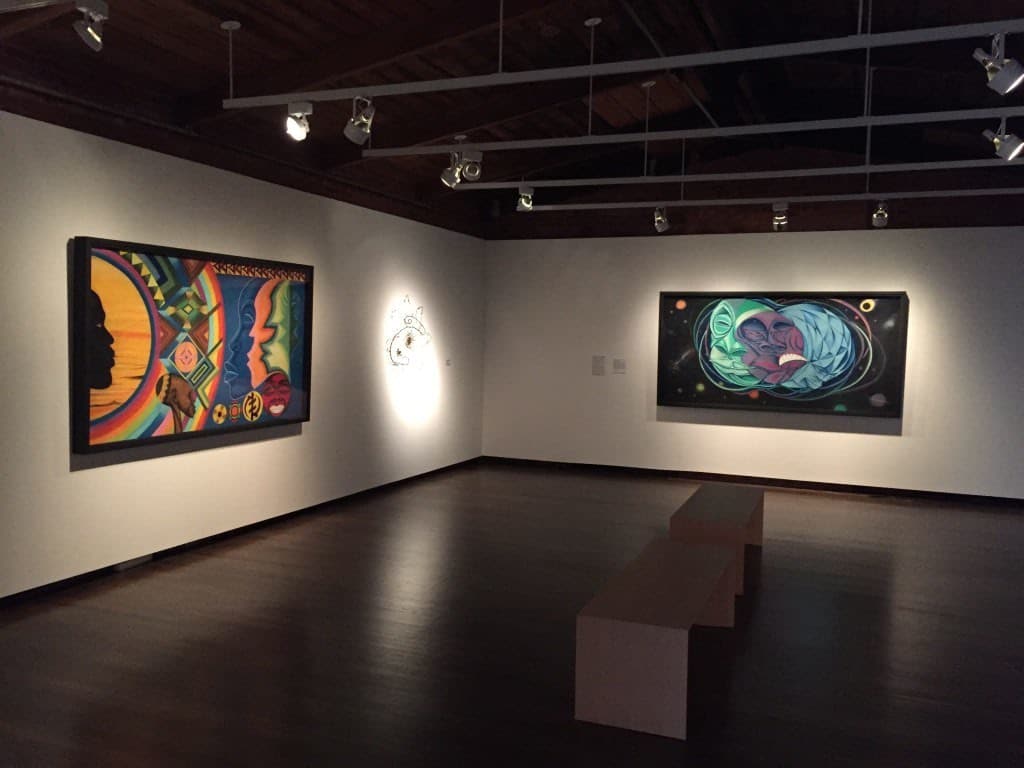
Amos Ashanti Johnson, African Rainbow and Hermes Trigmegistus, 1977, Mechanical Hall Gallery.

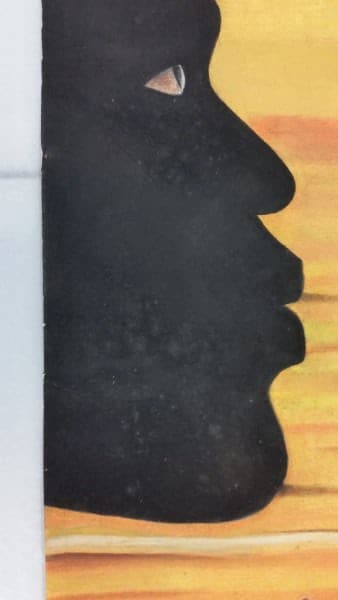
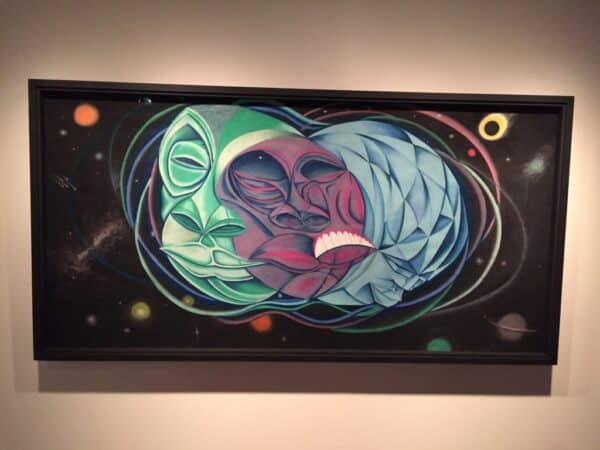
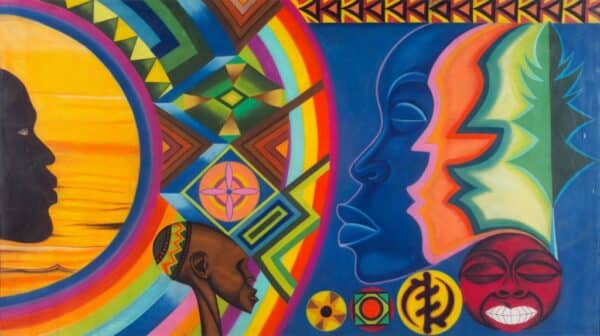
Hermes Trigmegistus and African Rainbow, pastels of exceptional size (47 ½ x 95 ½ in. and 47 ½ x 84 ¾ in. respectively), showcase Johnson’s expressive use of Afrocentric iconography and record the artist’s interest in cosmic universals. African Rainbow includes the profile of the artist’s face on the left hand side of the composition. According to Johnson, he completed three pastels of this size, all related; the third (location unknown) is titled Womb of Life. A drawing associated with Hermes Trigmegistus, titled Sister Senufo, is in the Paul R. Jones Collection of American Art at the University of Alabama, Tuscaloosa.

HERMES TRIGMEGISTUS

Hermes Trismegistus [sic] is considered the author of the Hermetic Corpus, a series of sacred texts that are the basis of Hermeticism. Johnson’s composition may be inspired by The Divine Pymander of Hermes Mercurius Trismegistus, one of the earliest of the Hermetic writings now extant. Hermes Trismegistus—or Thrice Great—is a syncretic combination of the Greek god Hermes and the Egyptian god Thoth. A messenger of the gods, Hermes is equated with Mercury, the planet closest to the sun. The constantly shifting, shimmering yet sharp qualities of the archetype are forcefully captured in Johnson’s centrifugal image. A new archetype associated with astrological texts, occult arts including alchemy, hieroglyphics and calendar keeping, Hermes Trismegistus is also a psychopomp—a guider of souls in the afterlife.

Amos Ashanti Johnson, Hermes Trigmegistus, 1977. Pastel on paper. 47 ½ x 95 ½ in. Paul R. Jones Collection, University Museums. © Artist or artist’s estate. Generous in-kind support of Optium Museum Acrylic for conservation of this work provided by Tru Vue, Inc. and Omega Moulding Inc.

AFRICAN RAINBOW

Johnson’s African Rainbow merges an Afrocentric iconography inclusive of Adinkra symbols—cultural emblems developed by the Asante of West Africa (Ghana and Côte d’Ivoire) to express popular proverbs and maxims—with an aesthetic popularized by AfriCOBRA. Borne out of the Civil Rights, Black Power and Black Arts Movements and founded in Chicago in 1968, AfriCOBRA artists created an aesthetic philosophy to guide their collective work—a shared visual language for positive revolutionary ideas, aimed to share with the African American community the truth and beauty of black self-identity. While Johnson is not affiliated with AfriCOBRA, African Rainbow and other works of his from the 1970s demonstrate the aesthetic and revolutionary influence of the Black Arts movement across the USA and the artist’s commitment to its message, iconography and visual style. Johnson shares with AfriCOBRA a desire to explore and define the Black visual aesthetic.

Amos Ashanti Johnson, African Rainbow, 1977. Pastel on paper. 47 ½ x 84 ¾ in. Paul R. Jones Collection, University Museums. © Artist or artist’s estate

NOTE FROM CONSERVATORS

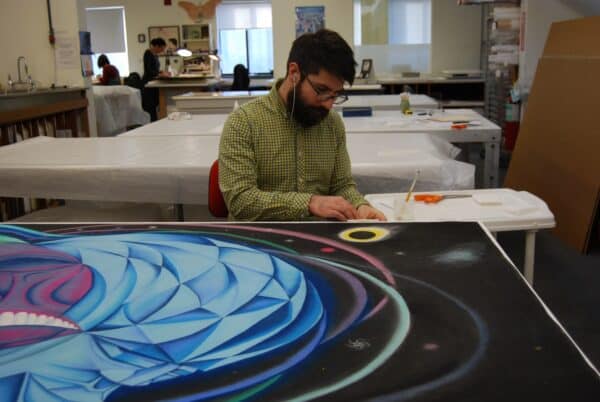
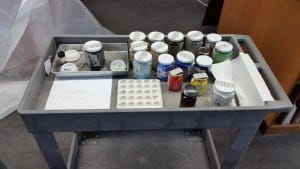
Conservator’s cart of supplies used for African Rainbow and Hermes Trigmegistus. Image courtesy of Conservation Center for Art and Historic Artifacts.

In November of 2014, conservators from the Conservation Center for Art & Historic Artifacts (CCAHA) visited the University of Delaware to inspect the condition of the Ashanti Johnson pastels, write condition reports, and prepare estimates. The pastels were in frames that were too small and had no separation between the acrylic glass, or “glazing,” and the surface of the art. Both of these factors contributed to the overall buckling, or “cockling,” of the paper. Aside from the framing issues, there were other issues that needed to be addressed: mold growth and damaging tape mends.
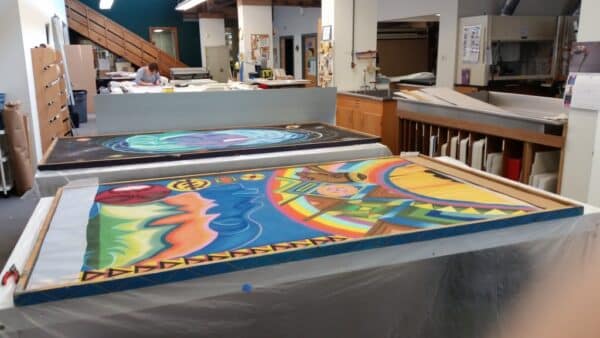
The pastels were delivered to CCAHA for conservation treatment and framing in July of 2015. Senior Paper Conservator Jessica Silverman performed the conservation treatment. The first challenge in working on the Johnson pastels was their enormous size. It took four people to safely handle the artworks anytime they needed to be moved.

The two untreated works African Rainbow and Hermes Trigmegistus arriving at the Conservation Center for Art and Historic Artifacts (CCAHA). Image courtesy of CCAHA.

The other key challenge in working on the Johnson pastels is the inherent friable, or crumbly, nature of pastels that have not been treated with a fixative. Some minor loss of pastel had to be accepted in order to reduce mold growth and to remove the tapes on the back, both of which were necessary for the long-term preservation of the artworks. In this way, the project exemplified an occasional aspect of conservation: compromise.

African Rainbow detail of mold on face before treatment. Image courtesy of Conservation Center for Art and Historic Artifacts.

Silverman reduced mold using pointed bamboo skewers dipped in an acrylic adhesive that remains tacky at room temperature. This technique allowed for the pinpoint removal of mold but some pastel media was inevitably removed as well. The masking and duct tape removal also presented a challenge. The pastels had to be placed face down—a dangerous position for the delicate artwork, which can easily rub off. Silverman placed the pastels on a slick, specialty paper and used a heated spatula to remove the tape. Next, she used discrete amounts of moisture to flatten the cockling. The careful combination of techniques and materials ensured a minimal amount of media transfer while the art was facedown.

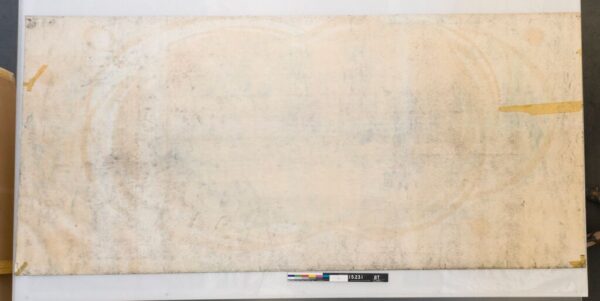
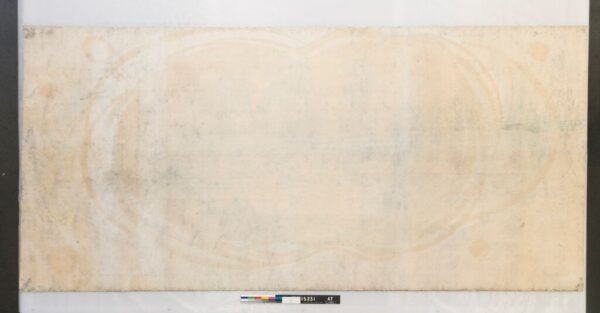
Verso of the Pastels

Hermes Trigmegistus back before treatment. Image courtesy of Conservation Center for Art and Historic Artifacts
Hermes Trigmegistus back after treatment. Image courtesy of Conservation Center for Art and Historic Artifacts.

Creating the housing and framing for the pastels was a challenge for the same reasons: the materials were oversized and the friable nature of the media needed to be accounted for. As noted above, the pastels were previously housed in frames that pressed the pastels against their acrylic glass glazing. When the artworks were removed from their frames, some of the color was left behind on the glazing. At CCAHA, it is customary framing practice to include a spacer to distance an artwork from the frame’s glazing in order to prevent this type of transfer. Along with designing a custom spacer for each of the pastels, CCAHA Manager of Housing & Framing Zachary Dell’Orto went a step further; he designed special gutters at the bottom of each frame to catch the trace amounts of pastel that could come loose.

Detail of gutter. Image courtesy of Conservation Center for Art and Historic Artifacts.

This will prevent these pieces of pastel from collecting within the bottom of the frame. As glazing, the University Museums at the University of Delaware selected Tru Vue Optium Museum Acrylic®, the only anti-reflective glazing product currently on the framing market that filters ultraviolet light and is also anti-static, essential for the housing of the large pastels.

Zac Dell’Orto working on Hermes Trigmegistus. Image courtesy of Conservation Center for Art and Historic Artifacts.

The historical and cultural importance of the Johnson pastels within the history of American art, as well as the unique nature of their medium and scale, make them excellent showpieces for the beauty of Optium.

African Rainbow and Hermes Trigmegistus document boldly and magnificently a seminal era in the history of African American and thusly American art. University Museums staff is thrilled to have them conserved, newly housed and on exhibition. We are grateful to the conservators and Tru Vue for furthering our ultimate goal—sharing the works with you.

University of Delaware alums are among the conservators who worked on the Johnson pastels: The initial site visit, condition reports, and prepared estimates were carried out by Gwenanne Edwards, graduate of the Master’s program in Art Conservation SUNY Buffalo ‘12 and UD undergraduate double major in Art Conservation and Art History ‘08, and Allison Holcomb, MS, Winterthur / University of DE Program in Art Conservation ’12.  Senior Paper Conservator & Preservation Consultant Jessica Silverman (MS, Winterthur / University of DE Program in Art Conservation ’08) performed the conservation treatment.

To learn more about UD’s art conservation program see: www.artcons.udel.edu/

About The Author(s)

Amy Heuer

Communications Coordinator, Conservation Center for Art & Historic Artifacts (CCAHA)
Amy Heuer is responsible for CCAHA’s publications, including Art-i-facts, a newsletter of ideas and information relevant to the conservation world, and FOCUS, a monthly publication highlighting specific treated objects. She also writes the annual report, manages the website, sends e-newsletters, and manages the Center’s social media.

Amy received her BA in Classics and Classical Archaeology from Brown University. She holds a Master’s degree in Medieval English with an emphasis on Old English and Old Norse literature from the University of Oxford. Prior to joining CCAHA, she interned at the Rhode Island School of Design Museum of Art in their Ancient Art and Education departments.

Jessica Silverman

Senior Paper Conservator & Preservation Consultant, Conservation Center for Art & Historic Artifacts (CCAHA)
Jessica Silverman holds a MS in Art Conservation from the Winterthur/University of Delaware Program.  She received her BA in Art History, with a minor in Chemistry and a certificate in Museum Studies, from the University of Illinois at Chicago. Prior to her work at CCAHA, Jessica interned in conservation labs at the American Philosophical Society; the Walters Art Museum; the Rijksmuseum (Amsterdam, Netherlands); the Winterthur Museum in Delaware; the Art Institute of Chicago; and at private paper conservation labs in Chicago.

Jessica completed two years as a post-graduate fellow at CCAHA before joining the staff in 2010. While at CCAHA, she has treated a variety of artifacts, including a 16th-century Persian miniature; William Penn indentures on parchment; Revolutionary War documents; an early-19th century pastel portrait by Micah Williams; a political map signed by Andrew Jackson; 19th-century photographic crayon enlargements; lithographs by Rosenquist, Renoir, and Audubon; French Art Nouveau posters; architectural drawings by Louis Kahn; and watercolors by Mary Louise Baker, Andrew Wyeth, and other 20th-century artists.

In addition to carrying out treatments, Jessica works with CCAHA’s Preservation Services Department, conducting preservation and vulnerability assessments for museums and archives throughout the country and writing disaster preparedness plans and preservation plans. She also presents preservation workshops to local professionals.

Julie L. McGee

Curator of African American Art, University Museums and Associate Professor, Black American Studies, University of Delaware.

Julie L. McGee, an art historian with specialties in African American art and contemporary African art, has published widely on contemporary African American art and South African art, with particular focus on artist and museum praxis. She joined the University Museums of the University of Delaware as curator of African American art in 2008 after a dozen years on the faculty of Bowdoin College and a Rockefeller Foundation fellowship at the Smithsonian Center for Folklife and Cultural Heritage. McGee has written and lectured extensively on African American art and contemporary art in South Africa. She has curated exhibitions for the David C. Driskell Center, the Bowdoin College Museum of Art in Maine, the Visual Arts Center of New Jersey and Guga S’Thebe Community Arts Centre in Langa (Cape Town), South Africa. With Vuyile C. Voyiya, McGee co-produced the documentary film The Luggage is Still Labeled: Blackness in South African Art. In 2011-2012 she held the Dorothy Kayser Hohenberg Chair of Excellence in Art History at the University of Memphis. She holds an appointment in Black American Studies as Associate Professor.

Shopping Cart
Scroll to Top