Conservation and Installation of a Large Scale Timeline for Mathematica at the Henry Ford
By Cuong T. Nguyen, Minoo Larson, Erin Murray
Mathematica: A World of Numbers…and Beyond is a permanent exhibit at The Henry Ford Museum of American Innovation at The Henry Ford (THF) that opened on September 23, 2017. The exhibit contains both kinetic and static representations of mathematical ideas from the 20th Century American designers Charles and Ray Eames. There are two other variations of the Mathematica exhibit at the Museum of Science, Boston and in the New York Hall of Science, Queens. The THF exhibit shows key interactive artifacts from the 1964 World’s Fair in New York that were on display at Seattle’s Pacific Science Center and the former Science and Technology Museum in Atlanta before being acquired in 2015. This article focuses on the conservation of a multi-media timeline measuring over 22 feet in length, and the collaborative journey that led to its final display design, including the fabrication of the largest seamed Optium Museum Acrylic® to date.
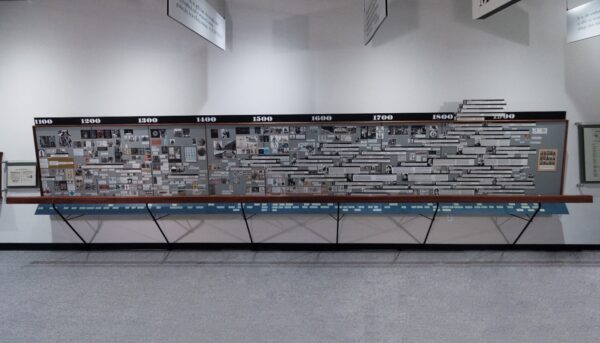
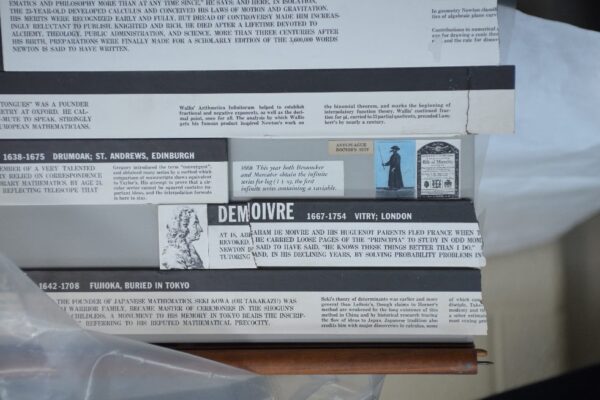
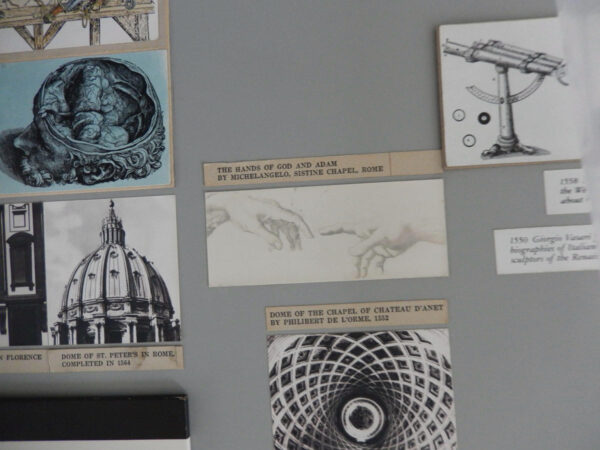
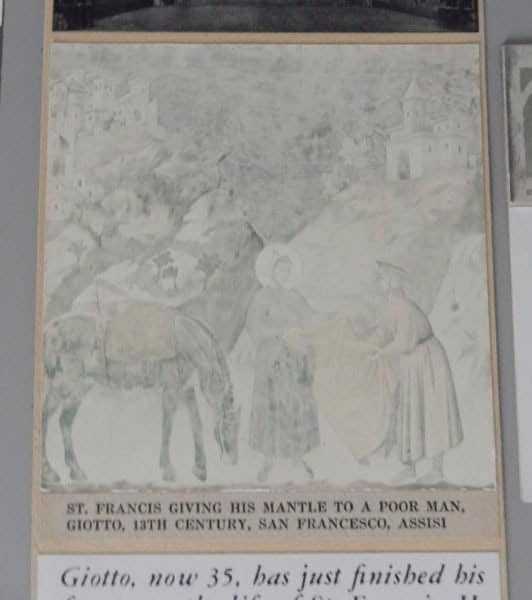
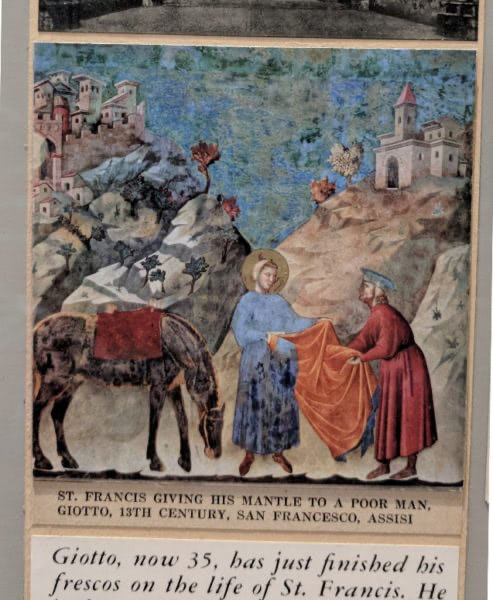
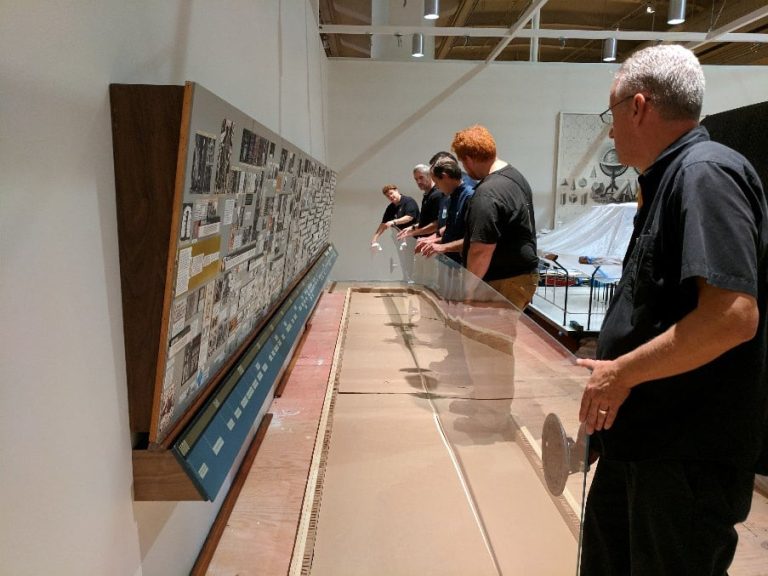
The History timeline for Mathematica is essentially a montage documenting events and discoveries related to mathematics spanning from 1100 to the 1900s (Figure 1). The timeline is comprised of nine parts (excluding its walnut handrail components), in which three main panels are joined together to form a 40” x 270” (101 x 685cm) montage. Short biographies of mathematicians and well-known historic and artistic facsimiles are affixed on to a painted Masonite fiberboard framed in walnut moulding. Each main panel has supplemental panels attached above and below, displaying dates, years, and historic events. The entire assemblage is displayed at an angle, leaning out from the wall slightly at the top.
Conservation of the History Timeline
Since the timeline was last exhibited, its overall condition showed only minor signs of damage. The most noticeable form of disfigurement was caused by light exposure, which resulted in fading of affixed photographs, cutouts, and prints. Other damage included a crack and small chips in the fiberboard. The panels warped, likely from the weight of the glass glazing as well as stress from the angle of display. The first panel had been reinforced previously and was not suitably sturdy for installation. A replica of this panel was made due to safety concerns for visitors and the potential risk of future damage.
An overall dry cleaning of the painted surface of the fiberboard was conducted and structural cracks were filled and mended.
Reproductions
While curators sought to retain all the original elements from the panels, the faded images affected the visitor’s ability to interpret the designers’ intent. Senior Paper Conservator Minoo Larson and Book Conservator Erin Murray devised a method using neodymium magnets to hold replica prints directly over the faded originals. Where it was not possible to use magnets, reproductions were secured with small L-shape pins. In all, twenty reproductions were mounted on the timeline through coordination with curators, the Creative Services, and the Exhibits departments (Figure 3).
The original glass glazing was lost before the timeline came into the collection. Curatorial research provided historic photographs of past exhibitions that assisted in its visual interpretation and selection of appropriate glazing, mounting elevation, and lighting.
Although laminated glass was considered, acrylic glazing was preferred. Acrylic is lightweight and helps avoid unwanted stress, is optical clear for easier readability, and its flexibility accommodates the warpage of the frame. Tru Vue® 6mm, Optium Museum Acrylic glazing was selected for its UV protection, abrasion resistance, anti-static, and optically clear properties.
Seamed acrylic was sought to reduce migrating dust and maintenance. SmallCorp was selected to fabricate the seamed Optium Museum Acrylic® panels; their proprietary process provided extremely robust seams that could withstand normal handling. The dimensions of the glazing were bespoke and specified for the seams to align in the voids between each panel. The fabricated glazing currently is the longest three panel, two seamed Optium Museum Acrylic® processed by SmallCorp, measuring 39 3/8” x 270 7/16” (100.0 cm x 686.9 cm).
Installation of the Timeline and Glazing
The installation of the glazing was a methodical process that involved collaboration from the Exhibits, Conservation, Experience Design, and Historic Operating Machinery team members.
The size of the glazing crate required that the timeline be the first item to be installed in the gallery. Initially, the protective film from the glazing was removed and six suction cups were used to span across the length of the seamed sheets. The glazing was held upright to remove the film on the verso, and the glazing was cleaned with 1:1 isopropanol: distilled water dilution on microfiber cloths prior to mounting. In order to fit the glazing, the top and side mouldings were temporarily removed, and the glazing was lifted simultaneously by six handlers onto the lower wooden moulding; the surrounding mouldings were then fit back into place. The remaining upper timeline components, bars and handrails were subsequently installed.
The completed installation of the Mathematical Timeline provided challenges that incorporated the diverse departments of THF and outside fabricators. The installation of seamed Tru Vue® 6mm, Optium Museum Acrylic glazing ensures that the artifact will be well-protected and clearly visible to the museum visitors for many years to come.
Acknowledgements
Within the Henry Ford, this project was a success, thanks to Collections Operations Manager Meredith Long, Jeff Dunlap and Sherri Howes at Institution Advancement, the Exhibits team, Chief Conservator Mary Fahey, Chief Curator Marc Greuther, and Curator Kristen Gallerneaux. A special thanks to Tru Vue for their in-kind donation of a sheet of 6mm, Optium Museum Acrylic and SmallCorp for their quality work in processing the seamed Optium Museum Acrylic.
About The Author(s)
Cuong T. Nguyen
Objects Conservator at The Henry Ford
Cuong T. Nguyen is an Objects Conservator at The Henry Ford in Dearborn, Michigan since 2015. He holds a MA Principles of Conservation and MSC Conservation for Archaeology & Museums from the Institute of Archaeology, University College London. Cuong is responsible for the scientific, transportation, computer and mechanically related artifacts.
Erin Murray
Book Conservator at The Henry Ford
Erin Murray is a Conservator of Books and Paper at The Henry Ford in Dearborn, Michigan. She holds an MA in Conservation from Camberwell College of Arts, University of Arts London. Erin works on paper based artifacts held within the museum, archives, and library collections.
Minoo Larson
Senior Paper Conservator at The Henry Ford
Minoo Missaghi Larson is a senior paper conservator at The Henry Ford. She has been responsible for the preservation management of all the 2-D artifacts in this institution for the last 35 years. The artifacts include works of art on paper, photographs, film negatives, books, maps, and archival collections. She received an MA in Museum Management and Archives from Bowling Green State University, Bowling Green, Ohio in 1982. Minoo apprenticed with James Craven, paper conservator at the Bentley Historical Library at the University of Michigan. She was a curator at the Azarbyjan Museum in Tabriz, Iran from 1975 to 1978. She is a “Professional Associate” of the American Institute of Conservation.