In semiconductor and electronic devices manufacturing, yield is everything. As device architecture becomes smaller, more complex, and increasingly sensitive, manufacturers face growing challenges in contamination, prevention, and ESD control in Semiconductor manufacturing environments.
A small electrostatic discharge (ESD), often imperceptible to humans, can damage sensitive components. Causing latent defects and contribute to costly yield loss. As fabs and electronics manufacturers work to optimize production efficiency, ESD control remains a critical element of facility design and process reliability.
One often overlooked factor in an ESD control strategy is the selection of materials used throughout the manufacturing environment. Machine guards, cleanroom partitions, equipment windows, and protective barrier parts must be considered for ESD control in semiconductor manufacturing. ESD-safe glazing materials like Tru Vue® Tru-ESD™ Polycarbonate and Acrylic can reduce static-related risks while maintaining visibility, cleanliness, and operational performance.
Understanding the Cost of ESD in Semiconductor Manufacturing
Electrostatic discharge occurs when accumulated electrical charges transfer between objects with different electrical potentials. In semiconductor manufacturing environments, these discharges can occur during routine handling, equipment operation, material transport, or interaction with non-conductive surfaces.
The consequences can be significant:
- Immediate device failure
- Latent defects that escape testing but fail in the field
- Reduced product reliability
- Equipment downtime and troubleshooting costs
- Lower overall manufacturing yield
As semiconductor geometries continue to shrink and device sensitivity increases, even relatively low-voltage discharges can be sufficient to damage components. This makes robust ESD mitigation strategies essential throughout the production ecosystem.

Hidden Sources of Static Electricity Generation
Many manufacturers focus primarily on grounding personnel, workstations, and equipment. While these measures are vital, static generation can also originate from materials installed around the manufacturing environment.
Traditional plastic glazing materials used for:
- Equipment enclosures
- Machine safety guards
- Cleanroom windows
- Viewing panels
- Process isolation barriers
can accumulate static charges through normal use and airflow. These charged surfaces may attract particles, increase contamination risks, and contribute to ESD events near sensitive production areas.
In semiconductor manufacturing, where contamination control and electrostatic management go hand in hand, material selection becomes a critical consideration.
Why ESD-Controlled Glazing Materials Matter
ESD-safe thermoplastics are engineered to dissipate static charges rather than allowing them to accumulate on surfaces. This controlled dissipation helps create a safer environment for sensitive electronic components and manufacturing processes.
Tru-ESD Polycarbonate and Acrylic products are specifically designed for environments where electrostatic protection and optical clarity are required.
Key benefits include:
Controlled Static Dissipation
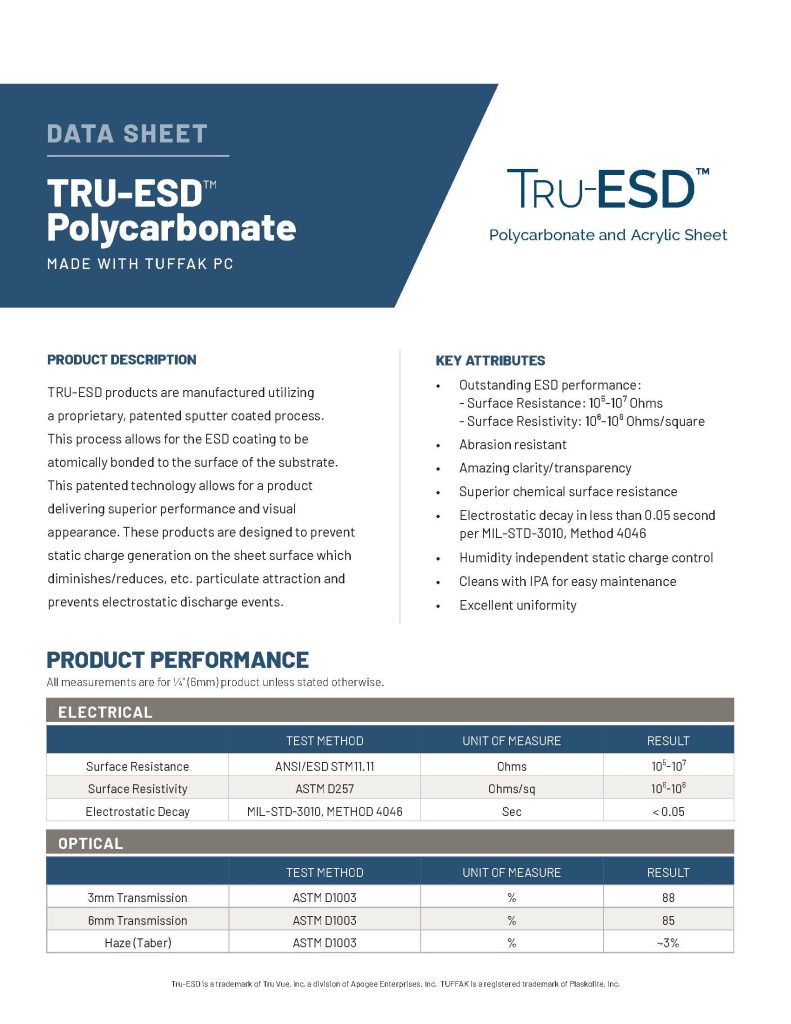
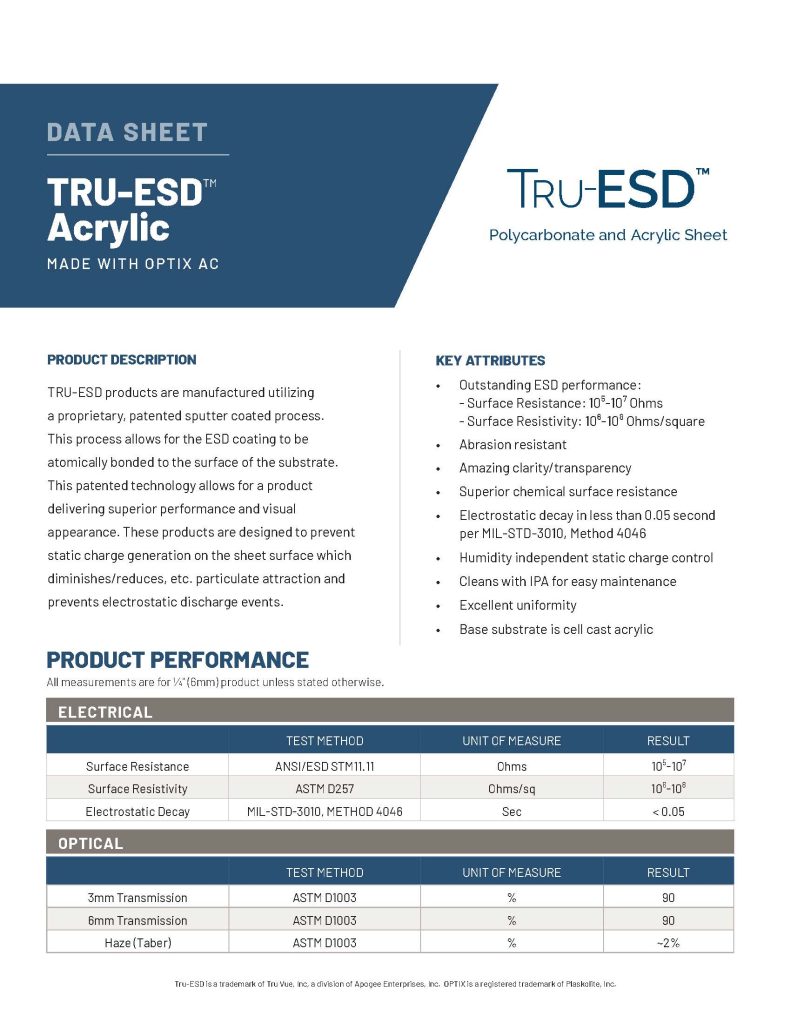
Tru-ESD materials help prevent charge buildup on surfaces by allowing static charges to dissipate in a controlled manner. Tru-ESD Acrylic and Polycarbonate feature a surface resistance of 10⁵-10⁷ ohms (ANSI/ESD STM11.11). Both maintain a surface resistivity of 10⁶-10⁸ ohms/sq (ASTM D257). This provides the static-dissipative performance required in ESD-sensitive manufacturing environments.
This controlled dissipation helps reduce the likelihood of electrostatic discharge events that can damage semiconductor or electronic devices assemblies.
Reduced Particle Attraction
Static-charged surfaces naturally attract airborne particles. In cleanroom and semiconductor environments, this can contribute to contamination concerns. By minimizing static buildup, Tru-ESD glazing helps reduce particle attraction and support cleaner manufacturing operations.
Tru-ESD products achieve electrostatic decay in less than 0.05 seconds (measured by the MIL-STD-3010 Method 4046). This helps to quickly dissipate charges before they can attract airborne contaminants or contribute to ESD events.
Excellent Visibility
Machine operators and technicians require clear visibility into production processes to monitor equipment performance, identify issues, and maintain quality standards. Tru-ESD Acrylic offers approximately 90% light transmission. Tru-ESD Polycarbonate provides approximately 85% light transmission, allowing excellent visibility into equipment and manufacturing processes. Both materials maintain a low haze value of approximately 2%, helping preserve optical clarity while supporting ESD control objectives.
Durable Equipment Protection
Used in machine guards, enclosures, and process equipment, Tru-ESD Polycarbonate provides robust impact resistance while maintaining electrostatic control properties. This combination makes it well suited for demanding industrial and semiconductor manufacturing environments.
Applications Within Semiconductor and Electronics Facilities
ESD-controlled glazing materials can play a key role across multiple areas of semiconductor and electronics production facilities.
Common applications include:
Equipment Enclosures and Machine Guards
Production tools frequently incorporate transparent panels that allow operators to inspect processes while maintaining safety. ESD-safe polycarbonate helps ensure that these viewing panels do not become sources of static accumulation.
Cleanroom Partitions and Windows
Maintaining both contamination control and electrostatic management is critical inside cleanrooms. Tru-ESD materials may be incorporated into partitions, barriers, and observation windows to support these goals.
Electronic Devices Assembly Areas
Printed circuit board (PCB) assembly, testing, and inspection operations often involve highly ESD-sensitive components. ESD-controlled acrylic or polycarbonate barriers can provide protective separation without introducing additional static risks.
Automated Manufacturing Systems
Robotic cells, automated handling equipment, and material transport systems frequently utilize transparent guarding. Incorporating static-dissipative materials helps protect products throughout automated manufacturing workflows.
Best Practices for ESD Control in Semiconductor Manufacturing
No sole product eliminates ESD risk. Effective ESD control in semiconductor manufacturing requires a combination of grounding systems, process controls, and static-dissipative materials throughout the facility.
- Grounding systems
- ESD-safe flooring
- Personnel grounding equipment
- Static monitoring programs
- Cleanroom protocols
- ESD-protected workstations
- Static-dissipative facility materials
By choosing ESD-controlled glazing materials for equipment and facility infrastructure, manufacturers can reduce static generation.

Building Yield Protection into Facility Design
As semiconductor manufacturers continue pushing the boundaries of performance and miniaturization, the cost of yield loss becomes increasingly significant. Every step taken to reduce ESD events can help protect valuable products, improve reliability, and support manufacturing efficiency.
Tru Vue® Tru-ESD™ Polycarbonate and Acrylic products provide a practical solution for incorporating electrostatic control into machine guards, cleanroom applications, equipment windows, and facility barriers. By combining transparency, durability, and static-dissipative performance, these materials help manufacturers create environments better suited for today’s extremely sensitive semiconductor and electronics production processes.
Protect Sensitive Processes with Tru-ESD™
Whether you are designing new semiconductor manufacturing equipment or upgrading an electronics production facility, Tru Vue can help. Use Tru Vue’s Tru-ESD Polycarbonate and Acrylic solutions to support your ESD control strategy. They also maintain the visibility and performance needed for modern manufacturing.
Learn more about the Tru-ESD product portfolio. Discover how incorporating static-dissipative glazing materials can strengthen your strategy for ESD control in semiconductor manufacturing while supporting semiconductor yield improvement and process reliability.
For more technical information on Tru-ESD products, please view the following resources: