
By Dr. Jennifer Booth, Tru Vue Fine Art and Museums Business Manager and Yadin Larochette, Tru Vue Museums and Conservation Liaison
Increasingly, museums and fine art institutions are contracting out for framing of art works and heritage items. The aim of this article is to help define the information needed from both the institution’s and framer’s perspectives, in the hopes that improved and stream-lined communication can lead to both a better framing package and potential savings in cost and time.
The priorities of an institution and those of a contract framer may not always coincide. Contracting for framing can be a time consuming process for both parties. Framers may spend many hours preparing a quote, taking into consideration both conservation issues and frame durability and longevity. Museums often require multiple quotes which are reviewed by different departments, each with their own parameters and budgets. There can be frequent back-and-forth questions from both sides, and framers will often differ in their methods and approach, resulting in quotes that can vary widely. These multiple layers of information, or lack thereof, can lead to mixed results. In some situations works can end up needing to be re-framed due to structural failure of the frame or, in more extreme cases, damage to the art work itself. One framer estimates that around 70% of works entering their workshop require conservation treatments prior to framing due to issues arising from past framing decisions.
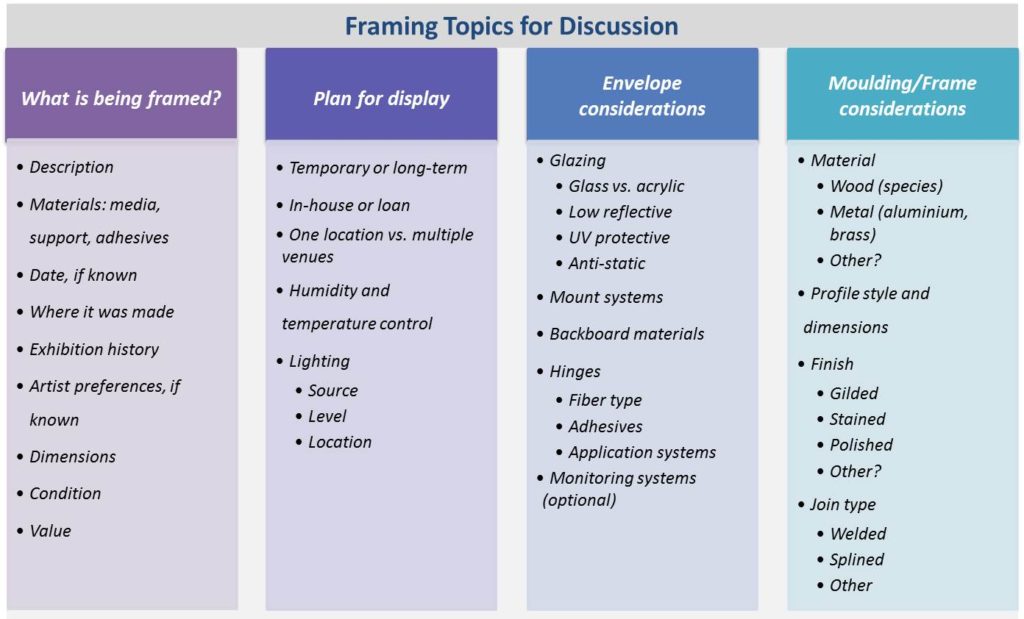
Full and open communication between customer and framer can reduce this risk. Critical information, such as high quality images with a ruler included for scale, and the type and current condition of the work, plays a large role in the success of the framing process. The material a work is made from, and its age and origin, may also dictate framing decisions. These could include, among other things, the moulding style and whether or not the interior of the frame should be sealed. Display location and lighting conditions may also influence glazing choice and package design. Although all of these details may seem extensive and excessive, sharing complete information from the beginning could save time in the long run. The outline below is designed to help get the conversation started, with the understanding that there may be other critical details specific to projects that are not included here.
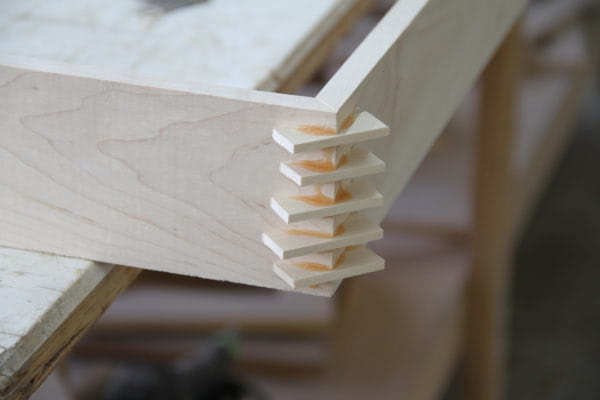
Taking all of the parameters listed above into consideration, basing the decision on who should frame the art work solely on cost can be a mistake. One framer may charge 20% less than another, but the quality of the work and materials used may be far inferior. Two aspects that can greatly influence cost and structural stability are the type of moulding join (pin joins are cheaper, splined joins are stronger) and the type of glazing (thinner glazing might reduce the price, but may be structurally less stable).
Scheduling can also play a large role in the overall cost. The earlier a framer is aware of a project, the easier it will be for them not only to source materials at the lowest price possible, but also plan ahead and budget work hours for the multiple employees needed. This can include designers, fabricators, fitters, and others involved in the project.
Continued communication with a framer after receiving a higher quote is recommended. Most framers want to know why their quote was rejected, and are often open and willing to work within budget constraints once they are aware of them, in order to better serve their clients. By continuing to communicate with the framer one may end up with a better product at a lesser cost.
As more and more institutions are contracting for framing, an increased understanding of how both museums and framers work can help facilitate the experience and offer the best quality framing package possible within budget. Looking at numbers alone can be misleading. Framing materials and construction choices may be based on quality and not necessarily reflect the lowest cost possible. A client shopping around should keep this in mind, especially if the decision to go with one framer over another is based on price alone. It is highly recommended to ask specific questions from each framer that is providing a quote to understand the reasons behind their choices.
Acknowledgements
- Jared Bark, Bark Frameworks
- Jane Berman, OTA House
- Friedrich Conzen, Conzen
- Elise Effmann Clifford, Fine Arts Museum of San Francisco
- Reinhold Gras, Sterling Art Services
- Victoria Hanley, National Museums Scotland
- Brian Isobe, F M Artist’s Service
- Matthew Jones, John Jones
- Patricia O’Regan, Fine Arts Museum of San Francisco
- Hannah Payne, John Jones
- Natasa Morovic, Fine Arts Museum of San Francisco
- Janice Schopfer, Los Angeles County Museum of Art
- Bryan Whitney, OTA House
About The Author(s)

Jennifer Booth
Tru Vue Fine Art & Museums Business Manager
Dr. Jennifer Booth, Tru Vue Fine Art & Museums Business Manager, has an archaeological conservation science background and previously worked with the Department of Conservation And Scientific Research of The British Museum whilst completing her D. Phil (PhD) at the University of Oxford. With her background, experience, and international network of arts and business professionals, Jennifer facilitates solutions to challenging glazing applications and develops innovative programs to service museum and conservation professionals, artists, and galleries.

Yadin Larochette
Tru Vue Museum and Conservation Liaison for the Americas
Yadin Larochette is a Museum and Conservation Liaison for Tru Vue. As liaison, Yadin helps build and manage relationships with clients ranging from large distributors to small business owners, and with end users such as art conservators, preparators, curators, collections managers, and private collectors of art and historic documents. Serving as a consultant and technical point of contact for end users and channel partners, she helps clients address product application challenges.
She received a BA in Art History from the University of California at Berkeley and an MS from the Winterthur/University of Delaware Program in Art Conservation. A fifth generation French tapestry weaver, she wove professionally before embarking on a career in textile conservation. She is a Professional Associate of the American Institute for Conservation and ran a textile conservation private practice for 10 years prior to joining Tru Vue in 2015.