Start with the application, not the material
Engineers developing defense displays, cockpit interfaces, vehicle HMIs, operator control panels, and rugged touchscreen systems often face an early choice between acrylic and polycarbonate. Both can serve as transparent cover materials, but they address different combinations of optical, mechanical, and environmental requirements.
The best choice depends on the complete use case. Consider what the operator must see, what the surface must withstand, how it will be cleaned, where it will be installed, and which qualification requirements apply. The substrate establishes the baseline. The surface solution can then be engineered to close performance gaps or add needed functionality.
When acrylic may be the better starting point
Acrylic is commonly evaluated when optical quality, surface appearance, and long-term weatherability are important. Its inherent surface hardness is generally higher than that of uncoated polycarbonate, which can help limit visible scratching during normal handling and cleaning. Acrylic may be a strong candidate when:
- Display clarity and image quality are primary requirements
- The interface has limited exposure to severe impact
- A clean, high-quality surface appearance matters
- UV stability and resistance to yellowing over time are design considerations
- Weight reduction compared with glass is beneficial

When polycarbonate may be the better starting point
Polycarbonate is commonly considered when impact resistance, heat resistance, and mechanical durability carry more weight in the specification. It can be well suited to mobile, vehicle-mounted, high-use, or protective applications where accidental impact and harsh operating conditions are realistic concerns. Polycarbonate may be a strong candidate when:
- Impact resistance is a critical requirement, and a virtually unbreakable, safer, and more durable alternative to glass is preferred
- The display is installed on a vehicle or mobile platform
- The cover may experience vibration, repeated interaction, or mechanical wear
- Shatter resistance and operator protection are priorities
- Ruggedization requirements outweigh the need for maximum inherent surface hardness
Base Substrate Comparison
| Design Consideration | Acrylic Base | Polycarbonate Base |
|---|---|---|
| Optical Clarity | Excellent inherent clarity and appearance |
Strong transparency with grade-dependent optical performance |
| Impact Resistance | Suitable where severe impact is not the primary risk | Virtually unbreakable; often preferred for high-impact applications |
| Surface Hardness | Generally harder than uncoated polycarbonate |
Lower inherent hardness; often coated for demanding environments |
| UV Stability |
Strong inherent UV stability and resistance to yellowing |
May require UV-stabilized grade depending on application |
| Heat resistance | Evaluate by grade and application requirements |
Often preferred when extreme-temperature performance is important |
| Common applications | Cover lenses, overlays, workstations | Vehicle HMIs, rugged displays, operator interfaces |
Looking beyond the substrate
Choosing acrylic or polycarbonate does not have to mean accepting only the substrate’s inherent properties. Tru Vue can combine transparent substrates with performance surface solutions that improve how the finished component functions in the application. Depending on the design and qualification requirements, engineered coatings can help:
- Reduce surface reflections and improve display readability
- Increase light transmission through an optical stack
- Improve resistance to abrasion and repeated cleaning
- Add chemical resistance for demanding maintenance environments
- Manage UV exposure
- Provide static-dissipative performance for sensitive electronics, cleanrooms, and controlled environments
This creates a more useful design question: Which substrate provides the right mechanical foundation, and which surface performance is needed to meet the full system requirement? In some applications, a coated acrylic can add durability and functionality while preserving strong optical performance. In others, a coated polycarbonate can retain its impact advantages while adding scratch, chemical, UV, or static-control performance.
Examples of added surface performance
Tru-AR™ Acrylic uses a wide-band anti-reflective coating to reduce glare and increase light transmission, with a durable hard coat for scratch protection.
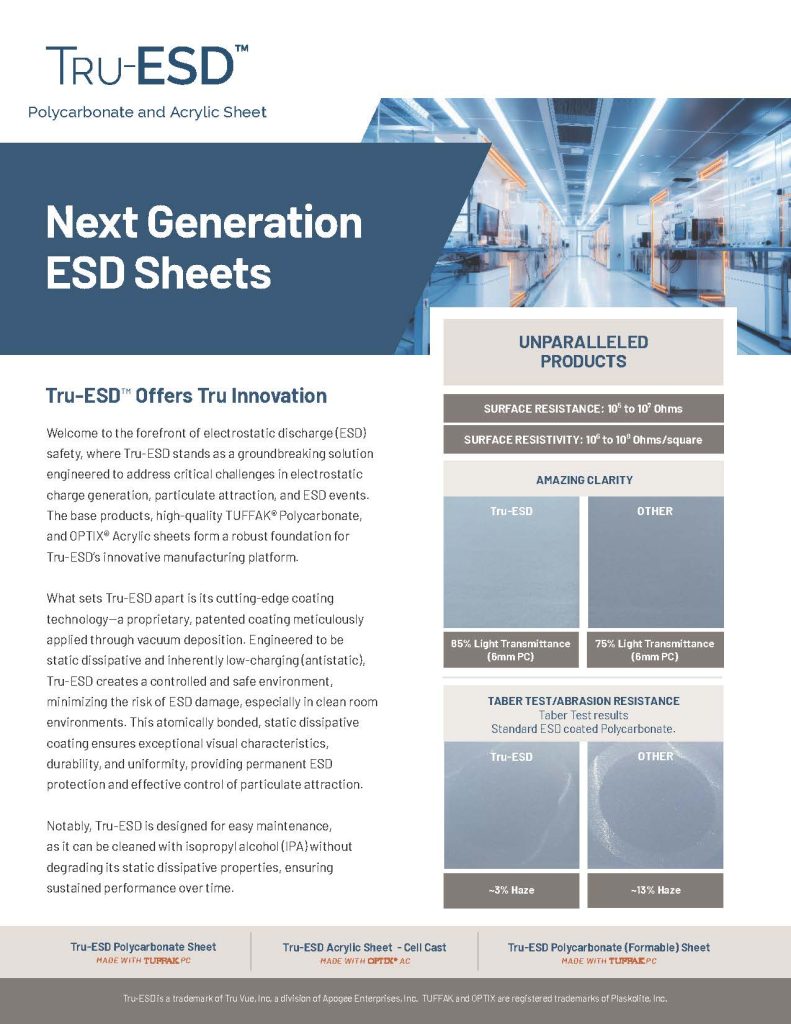
Tru-ESD™ Acrylic and Tru-ESD™ Polycarbonate add permanent static-dissipative performance with optical clarity, abrasion resistance, chemical resistance, and easy maintenance.
How Tru Vue Coating Technologies Can Enhance Polycarbonate and Acrylic Substrates
| Surface Technology | Performance Benefit | Application Value |
|---|---|---|
| Tru-AR™ Anti-Reflective Coating | Reduces glare and increases light transmission | Improves display readability, operator visibility, readability in direct sunlight, and viewing experience |
| Hard Coat Technology | Increases abrasion resistance and surface durability | Helps withstand cleaning, repeated use, and harsh operating environments |
| Chemical-Resistant Surface | Improves resistance to cleaning agents and chemicals |
Supports demanding maintenance and sanitization requirements |
| Tru-ESD™ Static-Dissipative Coating | Prevents static charge buildup while maintaining optical clarity |
Protects sensitive electronics and reduces particulate attraction |
| Optical Surface Engineering | Enhances visibility in challenging lighting conditions | Supports faster interpretation of critical information |
Performance varies by resin grade, thickness, coating system, fabrication method, operating environment, and qualification requirements. Tru-AR anti-reflective coating is not recommended for long-term outdoor use.
Evaluate the full operating environment
Defense displays and operator HMIs may be exposed to bright ambient light, vibration, temperature change, humidity, dust, cleaning chemicals, and repeated handling. These conditions should be considered together rather than as isolated checklist items.
For example, an impact-resistant cover that creates distracting reflections may not support fast interpretation of critical information. A highly clear surface that scratches during routine cleaning may also fall short over its service life. The right solution balances visibility, durability, cleanability, environmental exposure, and mechanical protection across the complete assembly.
In addition to optical and mechanical performance, engineers evaluating modern display technologies should consider environmental factors such as electromagnetic interference (EMI), which can influence overall system design, shielding requirements, and component integration.

A practical specification framework
- Define the optical target: Identify acceptable reflection, transmission, haze, contrast, and color requirements for the display and lighting environment.
- Define the mechanical risk: Assess impact, vibration, flex, mounting stress, operator contact, and shatter-safety needs.
- Map the environment: Document UV exposure, temperature and humidity range, dust, chemicals, cleaning methods, and expected service life.
- Identify added functionality: Determine whether the surface must provide anti-reflective, abrasion-resistant, chemical-resistant, UV-management, or static-dissipative performance.
- Validate the complete construction: Evaluate the substrate, coating, fabrication, bonding, and optical stack together against the program’s qualification requirements.
The right answer is a substrate-and-surface combination
Neither acrylic nor polycarbonate is universally better. Acrylic often provides a strong foundation for optical quality, appearance, and weatherability. Polycarbonate often provides a strong foundation for impact resistance and ruggedization. Engineered surface solutions can then improve performance and add features that the base material cannot provide on its own.
By evaluating the substrate and surface as one system, engineering teams can make a more informed specification decision and better align the cover material with the display’s real operating conditions.
Discuss your application with Tru Vue
Tru Vue offers engineered optical coating solutions designed to help improve display performance across demanding applications. Whether you’re developing a rugged display, transportation HMI, medical device interface, or operator control system, the right combination of substrate and surface technology can help achieve the performance your application demands.
Share your display environment, optical targets, durability goals, cleaning requirements, and qualification considerations with a Tru Vue technical specialist. We can help evaluate the substrate and surface solution combination that best fits your application.
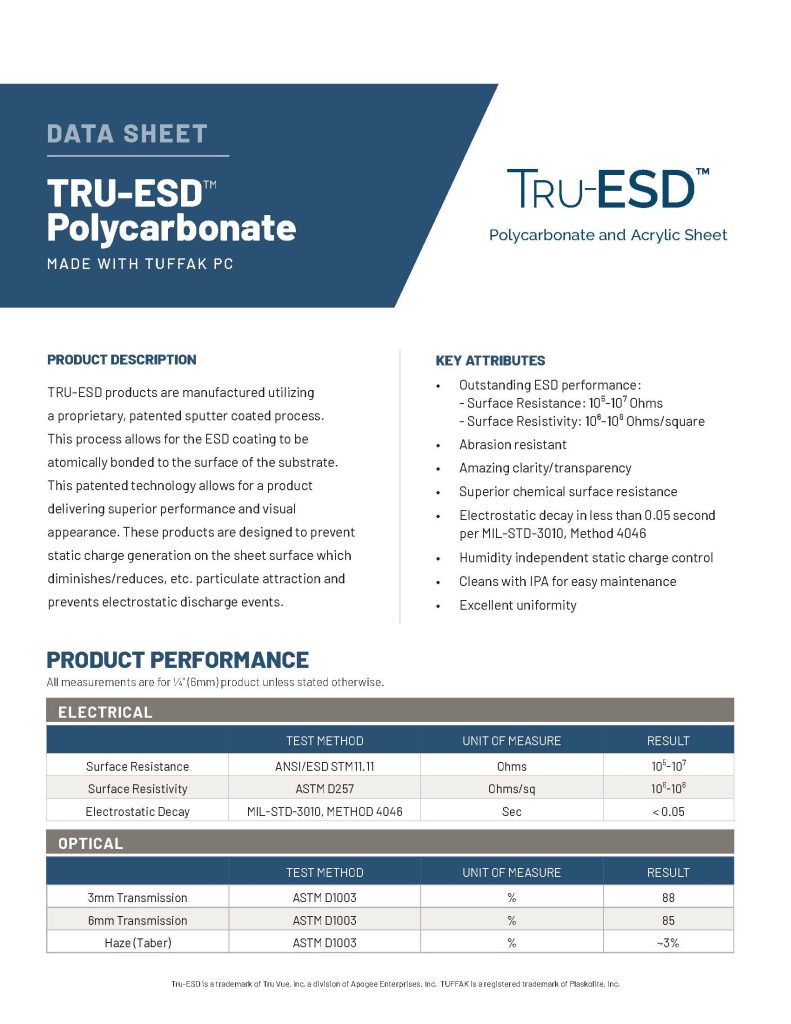
Tru-ESD Polycarbonate Product Data Sheet
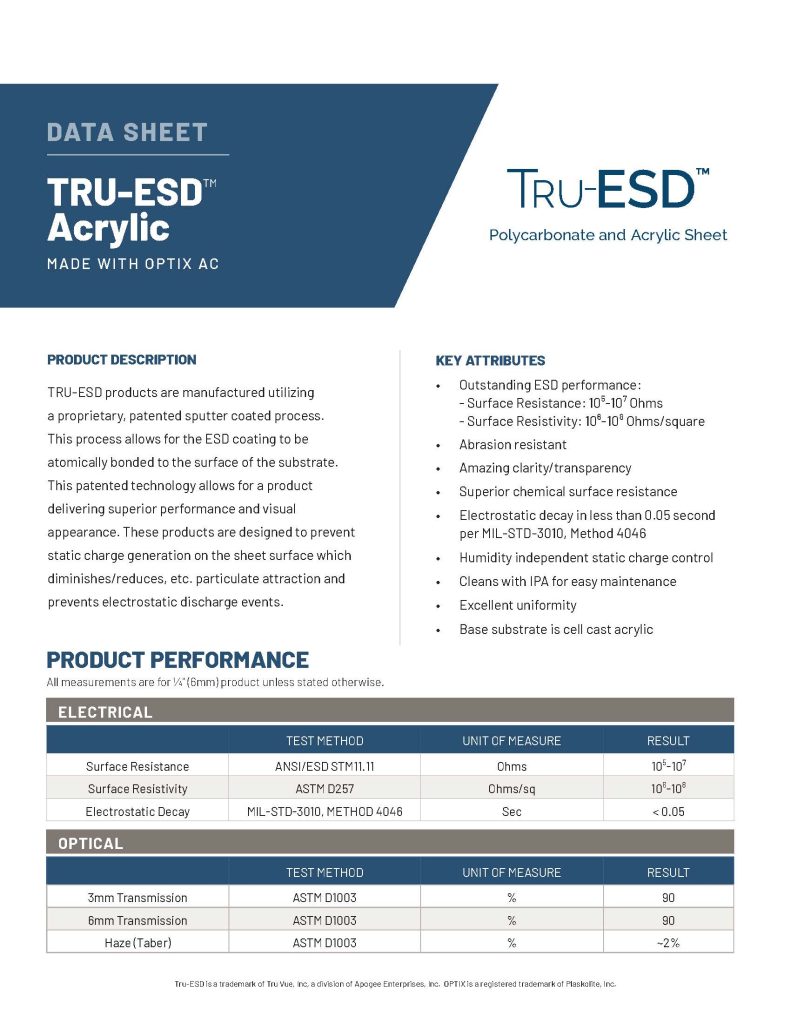
Tru-ESD Acrylic Product Data Sheet