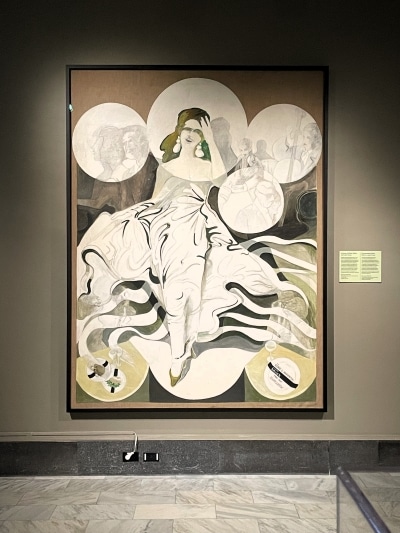
Restoring Mid-Century Chicago Nightlife: 1967 Ellen Lanyon Painting Conserved and Exhibited for First Time in 50 Years
By Kimberly Nichols, Director of Conservation Services, the Newberry Library
The Newberry Library is an independent humanities research library in Chicago, IL, that cares for and makes freely accessible a vast collection of rare books, manuscripts, maps, and other artifacts documenting more than six centuries of human experience. Among its holdings are several large paintings, including a six-by-eight-foot painting by artist Ellen Lanyon (1926-2013) that came to the library in poor condition in 2021. With the support of a generous Foundation for Advancement in Conservation (FAIC)/Tru Vue® Conservation and Exhibition Grant, the Newberry was able to conserve this painting and return it to public display for the first time in 50 years.
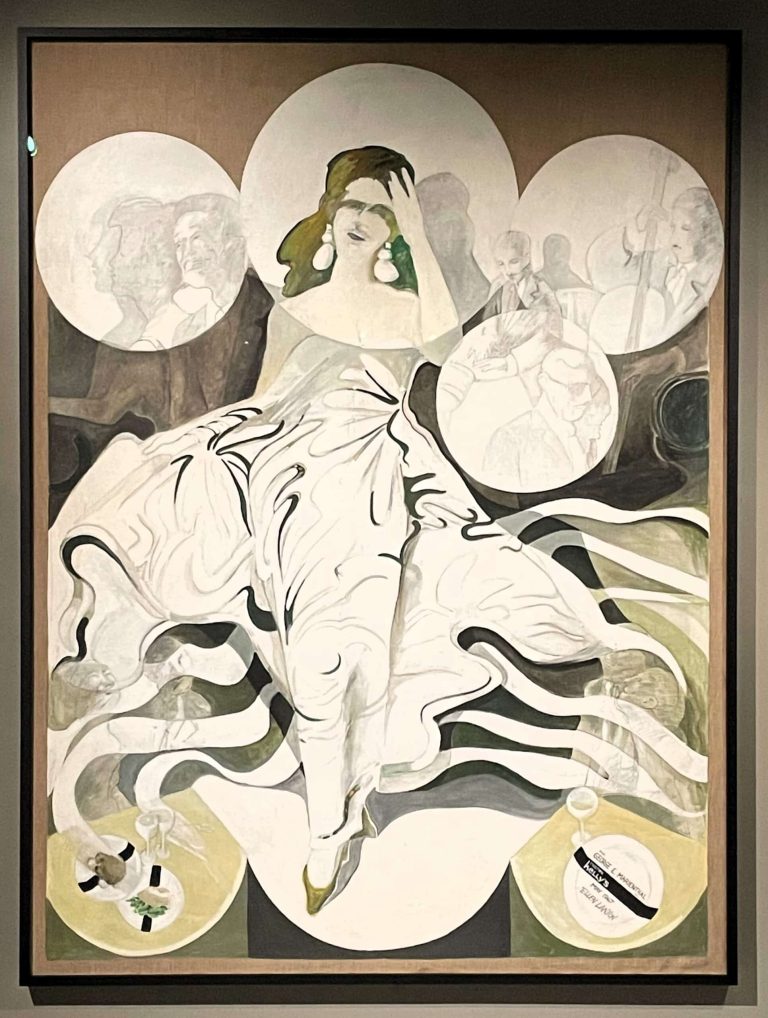
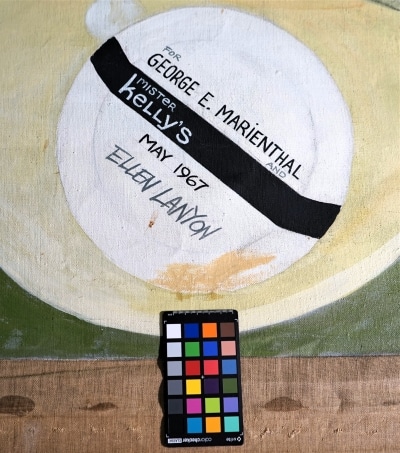
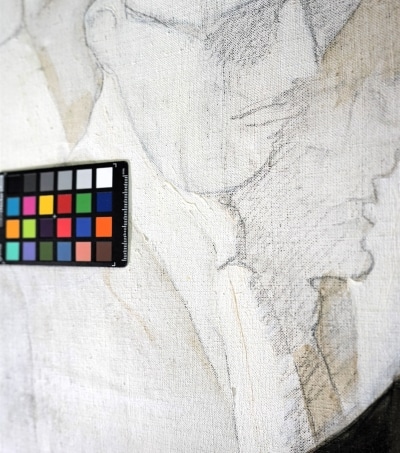
The untitled painting, descriptively known as “Woman in front of jazz band,” is an oil on unprimed canvas, most likely linen (W: 6’ H: 8’), that is thinly painted with exposed preliminary drawing in graphite and charcoal. It was commissioned in 1967 to celebrate the reopening of the Mister Kelly’s nightclub (1953-1975) following a fire. Located a few blocks from the Newberry itself, Mister Kelly’s was an intimate performance venue that, despite its small size, became a national tastemaker for entertainment. It cultivated seminal American artforms like stand-up comedy and jazz and helped popularize them through live recordings. Notably, it was among the only racially integrated performance venues in the United States outside of Los Angeles and New York. The club was known for supporting women and people of color at all stages of their careers.
In many ways, “Woman in front of jazz band” embodied the club’s inclusive ethos. The club specifically commissioned Lanyon, a female artist active in multiracial feminist circles, and the painting itself features racially diverse performers and audience members. From 1967 to 1975, the painting presided over thousands of performances. It also became one of the last large oil paintings created by Lanyon, who soon developed an allergy to the solvents used in oil painting and turned to other mediums.
When Mister Kelly’s closed in 1975, “Woman in front of jazz band” was transferred to a private apartment, where it remained until 2010. It was then removed from its original stretcher, transported to a new location, and push-pinned to a wall, leaving small tears in its margins. Later, the painting was rolled on a tube, face out. It was donated to the Newberry in this condition in 2021 as part of the larger Mister Kelly’s archives. Initial examination revealed that the painting’s surface was discolored by accumulated dust and grime as well as food stains and visible overpainting.
The Newberry’s Conservation team, which specializes in the conservation of works on paper, enlisted the help of painting specialists at L. Liparini Studio & Third Coast Conservation, LLC, to provide the care the painting required. After carefully examining and documenting the condition of the painting, the conservators removed dust from the canvas back and reduced surface soiling, staining, and overpaint on the painting’s surface. Where necessary, conservators consolidated unstable areas of paint. The painting was then stretched on a custom-made support and transferred to a local framer’s studio at Artifact Services, where it was glazed and framed.
The exposed graphite and charcoal elements are what initially led the Newberry to seek out a glazing solution. These elements are at higher risk of transfer or loss if something touches the surface, and they are sensitive to the static charge produced by many glazing materials. Protecting them from damage in a way that would not impair the public’s ability to view the artwork was critical. Optium Museum Acrylic® was identified as an ideal solution thanks to its anti-static properties and anti-reflective coating. In addition, its lighter weight when compared to laminated glass made the finished product easier to move and install for public display.
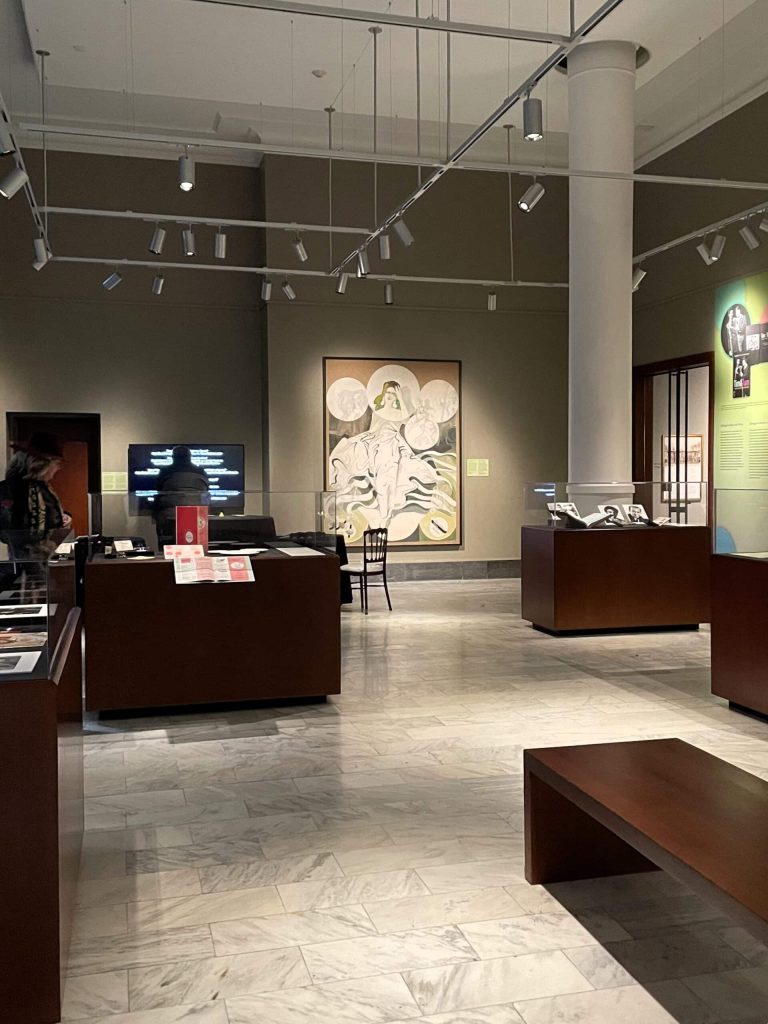
On March 19, 2024, “Woman in front of jazz band” greeted the public for the first time in nearly 50 years. Installed prominently in the Newberry’s spring exhibition A Night at Mister Kelly’s (March 19 – July 20, 2024), it was viewed by 12,176 visitors during the exhibition’s four-month run. At a preview of the exhibition, the son of the co-owner of Mister Kelly’s headed straight for the painting, exclaiming how beautifully it had been restored. Several exhibition visitors who themselves had attended the nightclub in the late 1960s and early 1970s remembered seeing the painting on display there and were thrilled to encounter it again, sharing memories with Newberry staff. Some of these recollections were recorded and added to the archive, helping to diversify the information available about the history of performing arts in Chicago.
“Woman in front of jazz band” has now been installed as part of the library’s permanent art collection. It is located just outside the office of the President and Librarian, where researchers and curious members of the public will continue to be able to access it, free of charge, for decades to come.
About The Author(s)
Kimberly Nichols
Director of Conservation Services, Newberry Library
Kimberly Nichols (MA with certificate of advanced study in art conservation) is a paper conservator with over 25 years of working in library and museum settings. In her role at the Newberry Library, begun in 2022, she oversees the care and conservation of a vast collection of rare and historical materials, including some 1.6 million books, 5 million manuscript pages, 600,000 maps, and tens of thousands of paintings, photographs, prints, and other artifacts.