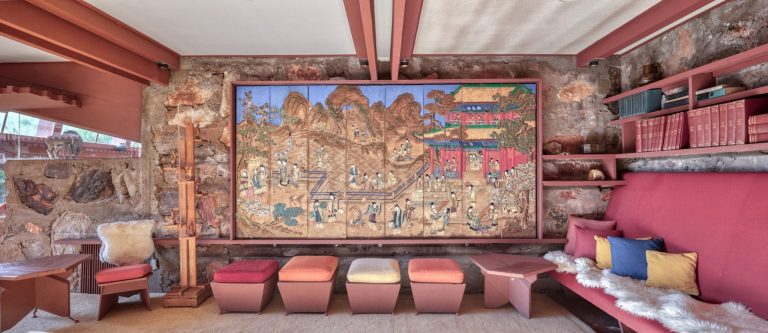
The restored Chinese screen in the Dining Cove at Taliesin West. Photo by Andrew Pielage. Courtesy the Frank Lloyd Wright Foundation, Scottsdale, Arizona..
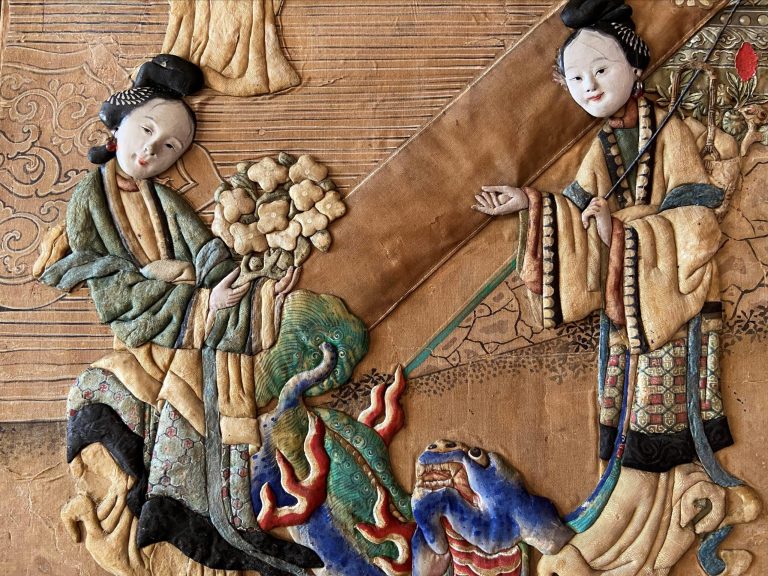
Detail of raised figures in "The Immortal Peaches" Chinese screen. Photo by Andrew Pielage. Courtesy the Frank Lloyd Wright Foundation, Scottsdale, Arizona.
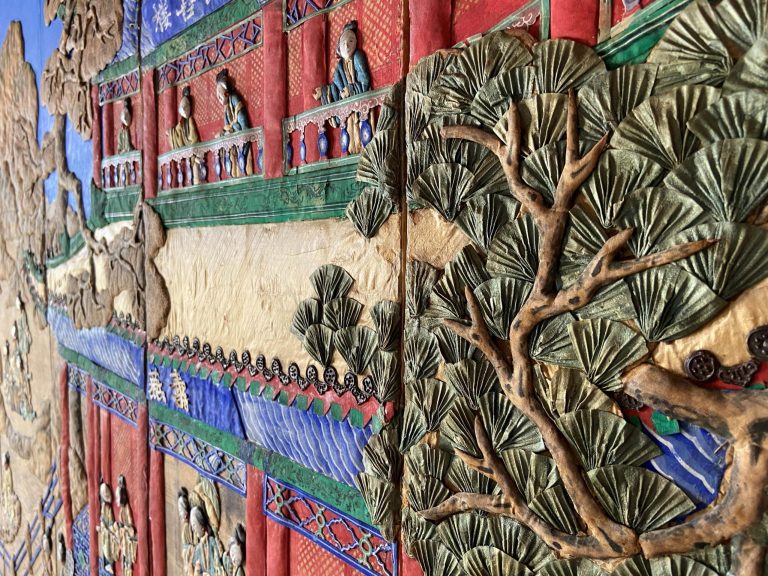
Side view of "The Immortal Peaches" Chinese screen. Photo by Andrew Pielage. Courtesy the Frank Lloyd Wright Foundation, Scottsdale, Arizona..
Location
Taliesin West, Scottsdale, Arizona
Medium
opaque watercolor on thin silk, lined with fabric, and adhered to a wooden strainer
Size
59.5 in x 109 in (151.1 cm x 276.9 cm)
Glazing
Optium Museum Acrylic®
The Challenge
To protect the light sensitive work from dust, fading and degradation due to ultra-violet light exposure. Large art work makes use of glass prohibitively heavy.
The Solution
Optium Museum Acrylic
Anti-reflective Allows viewers to see the screen without distracting reflections.
99% UV Blocking Protects the multi-media screen from the most damaging light wavelengths, helping prevent fading and degradation.
Shatter resistant Safeguards against injury and damage to artwork and visitors. This product is ideal for valuable works, high traffic areas, and public event spaces.
Abrasion resistant A durable hard coat protects against scratches from cleaning and general exposure to the public.
Anti-static protection exceeds that of glass Immediately eliminates static charge, making it the safest glazing for friable and loosely bound media, such as the aged dry powdery silk fibers from the screens.
The Work
This multi-media 8-panel screen probably dates to the late 18th – early 19th centuries and was possibly made for export. It is created with watercolor on thin silk, lined with fabric. The three-dimensional elements depicting flora, fauna, landscape, and costumes are fabricated from stuffed silk wrapped around cardstock with addition pieces of painted plaster or silk used for the faces.
More Info
Find product specifications, testing certifications, and more at the Optium Museum Acrylic product page.
Read about the restoration efforts at Taliesin West
Learn how the Collections & Preservation staff from the Frank Lloyd Wright Foundation work with conservation specialists to preserve and protect these magnificent historic screens while continuing to display Wright’s artwork for future generations to enjoy.
Learn more about the collaborative effort that has resulted in the secure reinstallation of the conserved work after 60 years in storage in our QuickVue.
For more information check out: “The Japanese and Chinese Paintings at Taliesin: Their Display and Conservation” by TK McClintock, Lorraine Bigrigg and Deborah LaCamera. Studies in Conservation Volume 65, 2020