Treasured items displayed in museums present a contradictory challenge, since the art works are there to be both observed and preserved, and conditions for optimal viewing may present preservation problems. Museum visitors love to see collections in bright light with no protective glazing, but these conditions can cause damage from overexposure to light and a host of other threats, including airborne pollution, visitors touching, and over active speech expectorants.
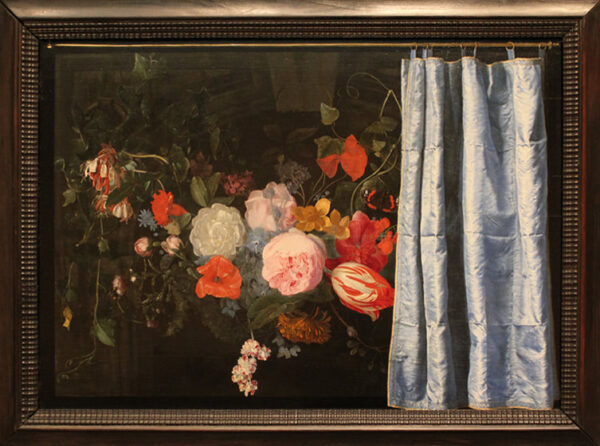
Paintings can be protected with applied coatings, like synthetic varnishes, but these materials can oxidize and degrade and their removal is not without perils. In the sixteenth century, only small lites of glass were available, which led to miniature paintings being the first to benefit from protective glass. Before clear glass was developed for use in buildings in the mid-eighteenth century, paintings were at times protected by curtains attached to their frames. Thinned sheets of tortoise-shell were also used at times.
Adriaen van der Spelt (Dutch, 1630-1673), Frans van Mieris (Dutch, 1635-1681), Trompe-l’Oeil Still Life with a Flower Garland and a Curtain, 1658, Oil on panel, 18 1/4 x 25 1/8 in. (46.5 x 63.9 cm), Wirt D. Walker Fund, 1949.585, The Art Institute of Chicago
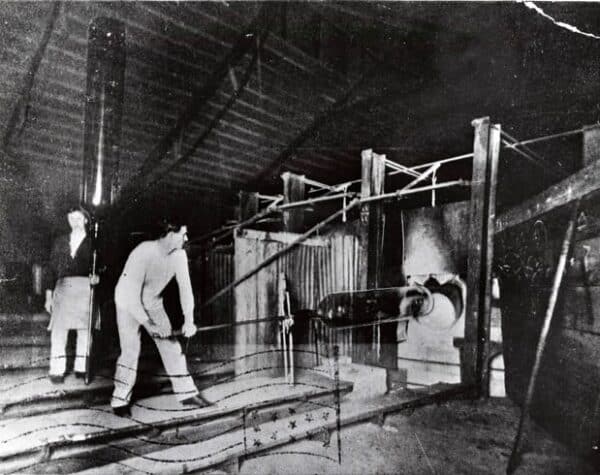
In the nineteenth century, as cylinder glass became available in larger sizes, the Tate Gallery in London began to use glass, in combination with backing boards, to protect their paintings, with measurable success.
Window glass blowing, blower with partly finished cylinder, unidentified, Wellsboro, no date. Photo: Division of Parks and Forestry Photograph Collection, New Jersey State Archives, Department of State.
In the earlier part of the twentieth century, museums in the U. S. displayed most of their paintings without protective glazing. Glazing was specifically reserved for works by such masters as Leonardo and Vermeer, since the dark surface of many older paintings made the glass highly reflective. In the latter decades of the twentieth century, reflection canceling glass became available and the benefit/risk equation began to shift.
The first reflection canceling coating manufactured in the U.S. was produced on an iron rich glass, and its optics were less than perfect; when it was laminated to itself, it was quite dark green, which limited its usage. In Europe, laminated glass with reflection canceling coatings was produced on low iron glass and was aesthetically quite successful. In the latter decades of the last century, reflection canceling glass and its laminated forms began to expand the role of sheet glazing, making more works available for loan and for long-term exhibition. This, combined with the technological advancement of Optium Museum Acrylic, which offered aesthetically pleasing anti-static and UV protection, at a lighter weight and less breakable than glass, tipped the balance in favor of glazing, and is now a standard part of a great many inter-museum loans and of extended display in this century.
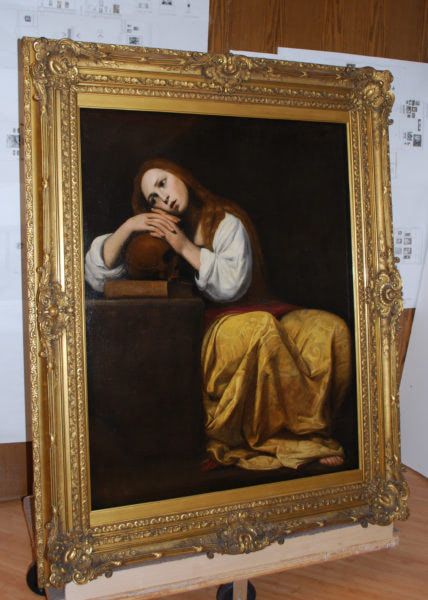
Giovanni Antonio Galli called Lo Spadarino, Saint Mary Magdalene, ca. 1625-1635, oil on canvas, 133 x 98.7 cm, Walters Art Museum, Baltimore, Maryland, 37.651. Displayed with Tru Vue Optium Museum Acrylic®.
One complication which affects the usage of Optium is the fact that acrylic sheets will warp when one side is wetter or drier than the other. This means that if a sheet of Optium is part of a sealed enclosure and it is moved to a challenging climate, this warping possibility must be taken into account. Laminated glass, like UltraVue Laminated Glass, is not affected by the warping problem and it is a vapor barrier, so it can be successfully used in long-term sealed enclosures and only its weight and fragility must be considered.
Today, well-lit reflection canceling glazing in a room without exposure to outdoor sunlight is virtually invisible to the viewer. This is a huge advance in preservation, since the most precious works can now be displayed while being protected from pollution, pests, and all contact with visitors. Future advances in making thin-film coatings less reflective of daylight and bringing together warp-free advantages of glass with the shatter-resistance of acrylic can write another page in this important preservation story.
About The Author(s)
Hugh Phibbs
Preservation Consultant
Hugh Phibbs began working in commercial framing in Washington, D.C., in 1976. Three years later, he joined the conservation staff of the National Gallery of Art. At the Gallery, he worked in the Paper Laboratory and the Department of Exhibitions and Loans, coordinating the preservation of works of art on paper, books and panel paintings on loan. He has written on preservation for Picture Framing Magazine and the Journal of the American Institute of Conservation. He also has taught preservation classes for the Smithsonian Resident Associates Program, the Professional Picture Framers Association (PPFA), the American Institute for Conservation of Historic and Artistic Works (AIC), the Centre de Conservation du Livre (CCL) in Arles, France; and the Institut National du Partimoine (INP) in Paris, France. He has given workshops to the staffs of The Louvre, The Hermitage, The Metropolitan Museum of Art, The Getty Museum, MoMA, The Harvard Libraries, and The Smithsonian Museums of Art. He is a professional associate of AIC and recipient of the University Products Lifetime Achievement Award. He retired from the National Gallery in 2014 and continues to write and teach about preservation, while working on innovations for the field.